What Drives Home Value In Ross's Luxury Market
July 9, 2026
July 9, 2026
If you have ever wondered why one Ross home commands a major premium over another that looks similar on paper, you are asking the right question. In Ross, home value is shaped by far more than square footage, and small differences in land, privacy, design, and future flexibility can change pricing in a big way. If you are buying or selling in this tiny luxury market, understanding those drivers can help you make smarter decisions. Let’s dive in.
Ross is not a typical Marin market. The town is about 1.6 square miles with roughly 2,453 residents, and it is largely built out with mostly single-family homes.
That matters because scarcity supports value. The Town of Ross notes there are no vacant parcels on the valley floor, and much of the remaining vacant land is in steep terrain, which limits easy new development and helps keep supply tight.
Current pricing also shows how distinct Ross is within Marin. As of May 31, 2026, Zillow estimates the average Ross home value at $4,049,034, Redfin reports a median sale price of $4.8 million for the three months ending May 2026, and Realtor.com shows a median listing price of $5.295 million with 7 active listings and a 26-day median time on market.
Those numbers measure different things, so some spread is normal. But taken together, they point to the same conclusion: Ross operates as a premium micro-market, not a typical suburb.
Ross also stands far above the broader county market. For the same period, Redfin reported a Marin County median sale price of $1.6 million.
That gap helps explain buyer behavior. People shopping in Ross are often evaluating a very specific mix of privacy, land scarcity, village character, and long-term value that they may not find elsewhere in Marin in the same way.
Redfin also classifies Ross as its most competitive market, with many homes receiving multiple offers and average sales moving in about 13 days. In a fast market like that, the homes with the strongest fundamentals tend to separate quickly.
In Ross, lot size alone does not tell the whole story. Usable lot area is often more important than total acreage, especially when slope, setbacks, lot coverage, and floor-area limits affect what you can actually do with the property.
Town zoning rules show minimum lot areas ranging from 5,000 square feet up to 10 acres depending on the district. Hillside lots with 30% slope or certain hazard-zone conditions can face tighter restrictions, which means two large parcels may have very different real-world value.
For buyers, this is a key distinction. A parcel that looks generous on a listing sheet may offer less functional yard space, less buildable area, or a more difficult improvement path than a smaller but flatter in-town lot.
Ross planning documents note steep topography, landslide hazard in the hills, and flood and liquefaction risk on much of the valley floor. These conditions can increase engineering, design, permitting, and construction complexity.
That is why flat and usable land often earns a premium. In a town with limited supply, properties with lower site complexity are simply easier to enjoy, easier to improve, and easier to market.
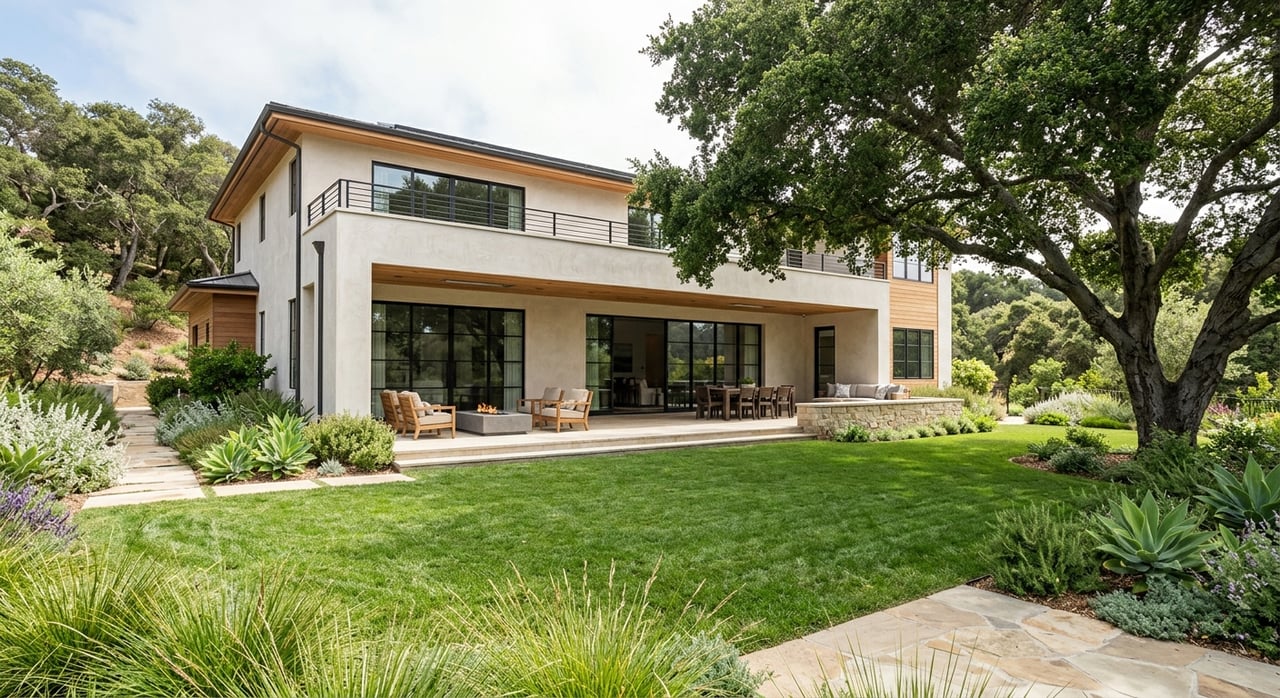
Luxury buyers in Ross are not just paying for size. They are also paying for a home that feels appropriate to its setting.
Ross’s General Plan encourages architectural variety, an open feeling, and design that blends with the neighborhood. The town’s design guidance also emphasizes buildings that recede into the background so landscaping and open space take center stage.
In practical terms, homes that feel calm, well-scaled, and integrated with their surroundings often perform better than homes that feel visually dominant. In Ross, architectural fit can be a value driver all by itself.
Ross also has a formal review structure that shapes value. The Design Review Ordinance requires Town Council approval for all new houses and additions over 200 square feet, and the General Plan notes a guideline maximum of 10,000 square feet of total floor area, with larger projects requiring a finding that the intensity is appropriate.
That means value is not only about how large a home is today. It is also about whether the design, scale, and improvement potential align with the town’s rules and character.
Privacy is a major part of the Ross luxury product. Town guidance highlights window placement, minimizing visibility from the street, reducing grading and retaining walls, and integrating buildings with the landscape.
Because of that, a home’s siting can strongly influence value. A property that naturally shields the house from the road while preserving sunlight, outdoor space, and a sense of openness may command more than a larger home with a more exposed setting.
This is one reason Ross pricing can seem hard to explain from photos or square footage alone. Buyers often respond to how a home feels on the site, not just how big it is.
About half of Ross housing stock was built in 1939 or earlier, according to the town’s Housing Element update. Many homes are also nonconforming under current zoning because they were built before modern floor-area limits.
That can cut both ways. An older home may offer character and a prime location, but it may also come with expansion limits, variance needs, or added planning complexity if you want to remodel.
The same town source notes that alterations often require variance requests to preserve existing nonconformities. So when you compare homes in Ross, it is smart to look beyond finishes and ask a deeper question: how easy will it be to improve this property in the future?
In Ross, permit history can have real pricing power. A home with a clean record and a straightforward path for future work may be more valuable than a similar home with unresolved nonconforming issues or a more complicated approval path.
Town reports also show that Ross uses design review and demolition rules to preserve neighborhood character and scale. Replacements after demolition must be sensitive to surrounding character, which reinforces the importance of thoughtful architecture and good documentation.
For sellers, this means preparation matters. If your home has completed improvements, permits, plans, or clear records that reduce uncertainty, those details may strengthen buyer confidence and support pricing.
Even in a small town, micro-location plays a role. The Town of Ross identifies Ross Common, the post office, Ross School, the downtown commercial area, and the civic center as the heart of the community.
Homes closer to this core often benefit from convenience, a stronger sense of connection to daily town life, and a more walkable feel. In a market where lifestyle and setting matter, that proximity can add meaningful appeal.
Ross is about 1.5 miles west-southwest of San Rafael and centrally located in Marin County. That helps give buyers a blend of close-in convenience and a separate village feel.
The town’s planning documents also describe Ross as a place defined by historic character, small-town charm, tree-lined streets, and wooded hillsides. Buyers are often paying for that full setting, not just the house itself.
If you are preparing to sell in Ross, the strongest marketing story usually goes beyond finishes and room count. Buyers want to understand the total package.
Focus on the features that most often support premium pricing:
In a market this nuanced, strong presentation matters. So does a pricing strategy grounded in how Ross buyers actually evaluate value.
If you are buying in Ross, it helps to think in three layers: the land, the house, and the entitlement path. Looking at only one of those pieces can lead to overpaying or overlooking risk.
Here is a practical checklist to keep in mind:
These questions can help you compare properties more accurately, especially in a fast-moving luxury market where competition can pressure buyers to decide quickly.
In Ross, home value is rarely explained by square footage alone. The biggest premiums usually come from scarce and usable land, strong architectural fit, privacy, thoughtful siting, proximity to the town core, and a cleaner path for future improvements.
The biggest discounts often show up when a property has steep topography, more hazard exposure, less functional land, or added entitlement and renovation friction. If you understand those value drivers before you buy or sell, you will be in a much better position to make a smart move.
If you are thinking about buying or selling in Ross and want clear, local guidance on how a specific property may be valued in today’s market, Janey Kaplan can help you think through the details with a strategic, hands-on approach.
Stay up to date on the latest real estate trends.
Get assistance in determining current property value, crafting a competitive offer, writing and negotiating a contract, and much more. Contact me today.